Range Repair
Viking burner clicks but will not light: reading the spark
Written by Keiko Mabuchi Service technician — cooktops and ventilation · 11 years in the trade
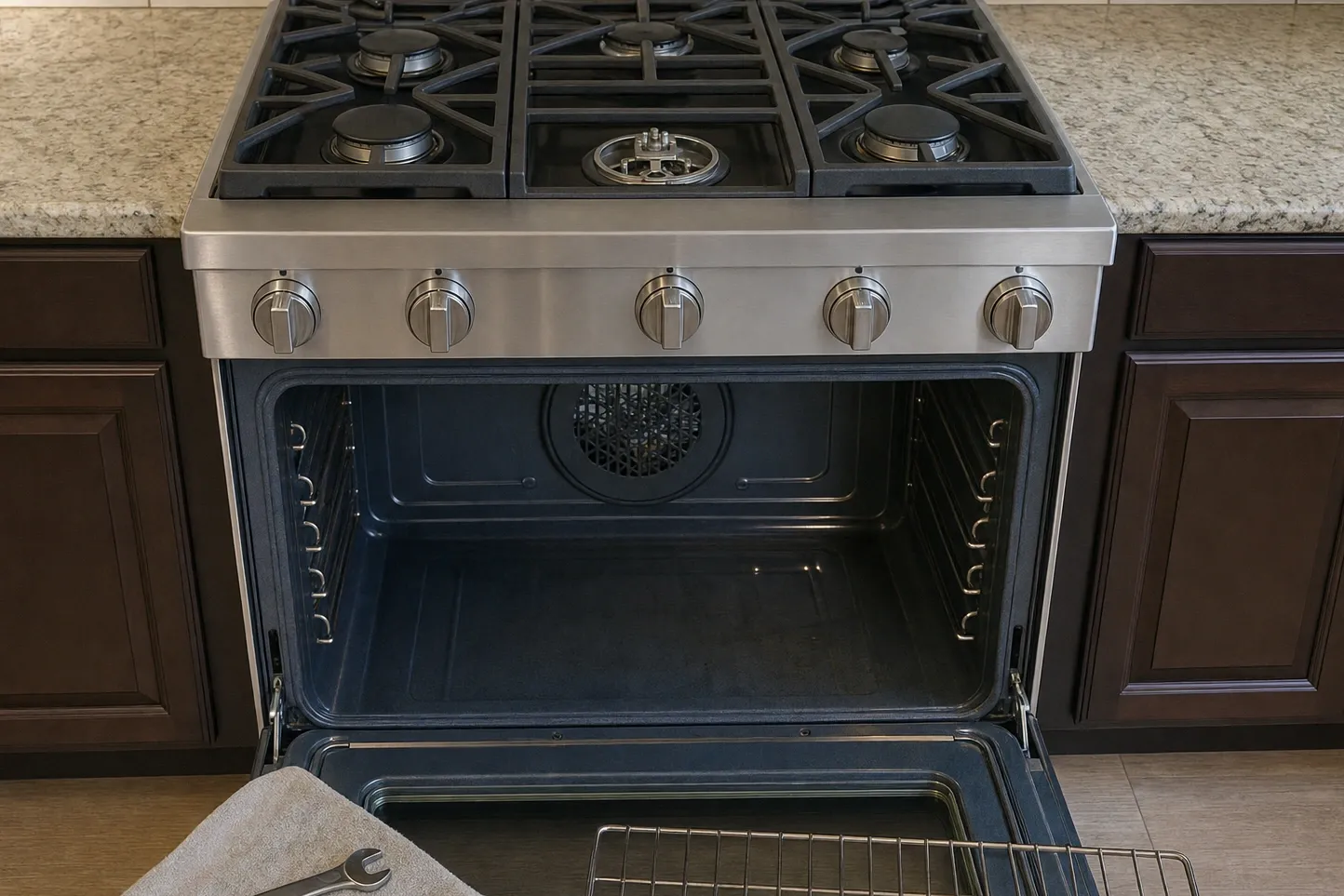
A Viking sealed burner that keeps clicking after the flame is up is one of the most common calls we take across the Westside, and one of the least likely to need an expensive part. The clicking is not a fault light. It is the spark circuit reporting, quite accurately, that it cannot confirm a flame — and there are only a handful of reasons for that.
Worth saying at the start: the noise itself is harmless. What matters is whether the burner is lighting cleanly and immediately. A burner that clicks for a second or two and then settles has one problem. A burner that clicks, pauses, and catches with a thump has a different one, and that second one should be switched off until somebody looks at it.
What the clicking actually is
Under each sealed burner there is a spark electrode — a small metal pin in a white ceramic insulator, sitting a couple of millimetres from the burner ring. A spark module behind the control panel puts a few thousand volts across it, the spark jumps that gap to the grounded burner base, and the gas lights.
On most professional rangetops that same electrode does double duty. Once the flame is up, the module looks for a tiny current flowing through the flame itself, from electrode to burner base — a flame is slightly conductive, and that current is how the range knows there is fire rather than raw gas. If the module cannot detect it, it does the only sensible thing available to it and keeps sparking.
So continuous clicking almost always means one of three things: the electrode is not seeing the flame, the electrode cannot pass current cleanly, or the module has weakened. All three are cheap next to a control board, and two of them are often not parts at all.
The two things that soak an electrode
The first is a boil-over. Sugar, milk, stock and salted pasta water run down into the burner well and dry onto the ceramic insulator as a conductive crust. Now the module’s voltage has somewhere easier to go than across the spark gap: it leaks down the crust to the burner base. The spark looks weak or lands in the wrong place, and the flame-sense current gets swamped. The burner may light from a neighbouring flame and keep clicking anyway.
The second is water — usually cleaning water, sometimes just the fact that we are on the coast. Salt air is not corrosive to a burner in any dramatic way, but it settles as a film that holds moisture, and a Palisades or Brentwood kitchen that opens onto the marine layer every morning gets a damp electrode by dawn. That produces the pattern people describe as “it never lights before mid-morning, then it works all day”. A weakening spark module shows the same daily rhythm, because a marginal spark fails first when the air is wet.
What to check before calling anyone
None of this needs tools beyond a torch and a dry cloth, and all of it is safe with the burner cold and off.
- Lift the burner cap off and set it back on deliberately. Caps locate on pins or a lip; a cap sitting a few degrees out puts the flame away from the electrode, which is enough on its own to keep the module sparking.
- Look at the electrode tip. You are looking for a brown or white crust on the ceramic, not for damage. If the ceramic is cracked or chipped, stop — that electrode needs replacing and no amount of cleaning will fix it.
- Dry it properly. A hair dryer on its cool setting for a few minutes, or simply leaving the cap off overnight, resolves a surprising number of these. If the burner lights normally after drying and starts clicking again a week later, you have a water path rather than a one-off spill.
- Check the burner ports with a straightened paperclip or a pin — not a toothpick, which breaks off in them. Blocked ports make a ragged, uneven flame that never reaches the electrode properly.
- Note whether one burner clicks alone or all of them click together. That one observation narrows the call further than anything else you can say down the telephone.
When it is the module rather than the electrode
Because the electrodes are wired to one module, a single electrode that has gone to ground will make every burner on the range spark. People reasonably conclude the module has failed, and it is the most frequent misdiagnosis we undo.
The test is mechanical. With the top off, the leads come off the electrodes one at a time; when the clicking stops, the electrode you just disconnected is the one shorting. If the clicking continues with every lead off, the module or the switch under the knob is next — a switch that does not fully open keeps calling for spark with the burner off.
A module that is simply tired is harder to see and easy to measure. It sparks, but with a shorter, thinner arc, and it fails on damp mornings and marginal gas pressure while looking perfectly fine on a dry afternoon. That is a part, and it is a fraction of the cost of the board people are often quoted instead.
When to stop and call
Switch the burner off and leave it if you get any of these: a gas smell that lingers before it catches, a burner that lights with a bang, soot on the pan supports or the wall behind, flames that are orange and lazy across the whole rangetop, or a cracked ceramic insulator. Delayed ignition is gas collecting before it finds a spark, and it is the one symptom on this list that is genuinely worth being cautious about.
The same goes for knobs that have stiffened. That is the valve stem rather than the spark, and forcing one is how a straightforward strip-and-regrease turns into a replacement valve.
For everything else — a clicking burner that lights fine, a burner that will not light on damp mornings, one burner out of six behaving differently — an hour with a meter usually settles it. The visit and the diagnosis are a flat $89, and that comes off the repair if you go ahead with it.
Loose ends
Is a burner that carries on clicking once it is lit safe to use?
For a short while, yes — the spark is low current and the gas is already burning. What is not safe is a burner that lights with a bang, smells of gas before it catches, or throws soot. Those are ignition-delay symptoms and the burner should be left off until somebody has looked at it.
Can I just light it with a match until it is fixed?
On most sealed burners you can, and plenty of people do. Turn the knob to its lowest setting, light at the burner ring rather than over it, and never hold the knob open waiting. If the burner needs more than a second or two to catch, gas is pooling and you should stop.
If one burner clicks, does the whole spark module get replaced?
Usually not. The module fires the electrodes together on many Viking rangetops, so one contaminated electrode makes every burner click — which is why a single bad electrode is often misread as a failed module. Disconnecting leads one at a time tells you which it is in a couple of minutes.