Range Repair
Getting a 48-Inch Viking Through the West Gate: Access, Staging and Carry Planning in Bel-Air and the Brentwood Canyons
Written by Keiko Mabuchi Service technician — cooktops and ventilation · 11 years in the trade
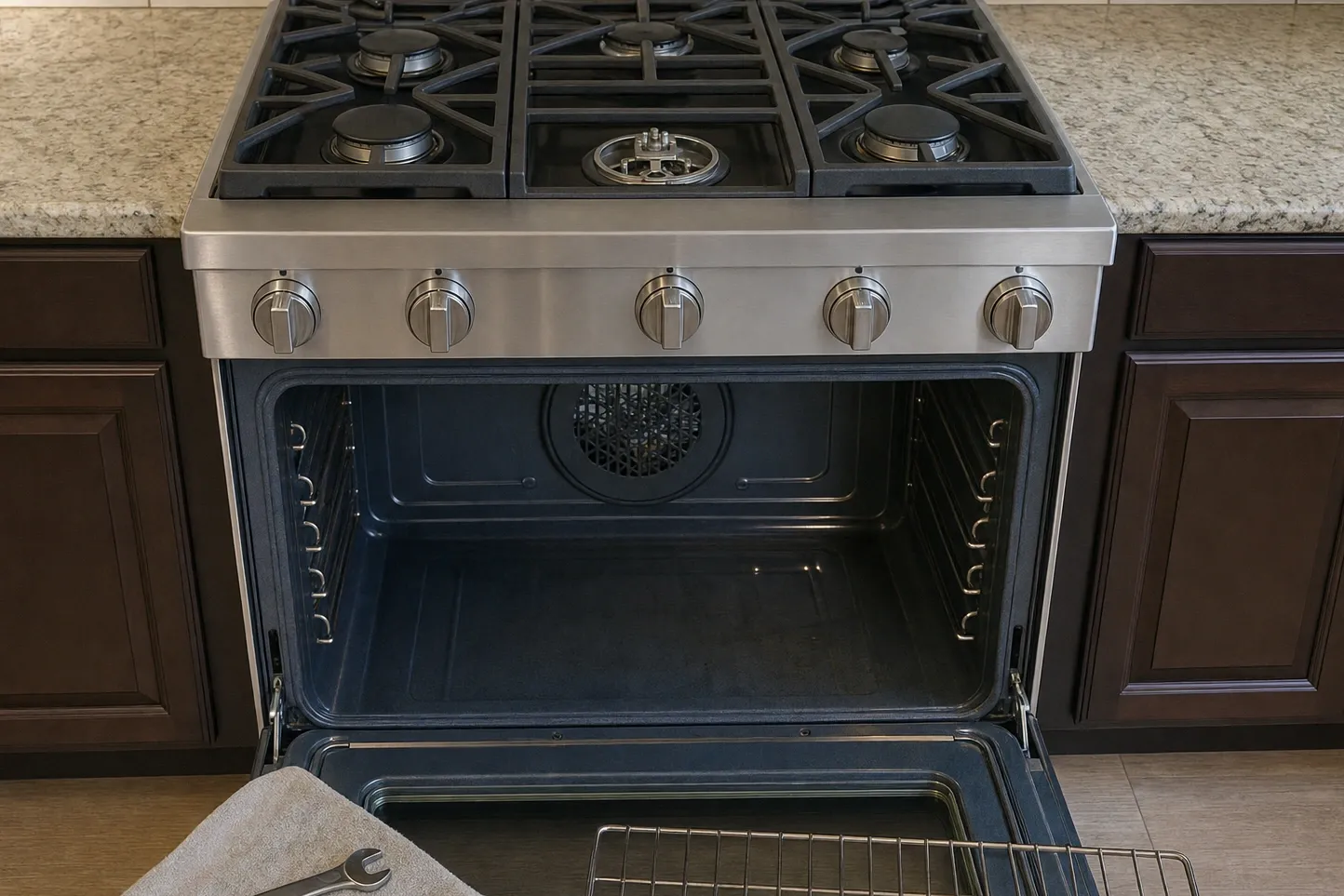
The question worth asking first
Not what is wrong with the range. How the truck reaches the kitchen. In most of the city that question answers itself; above Sunset it determines what a first visit can realistically finish, and it is worth settling before anyone books a date.
Bel-Air is entered through two association-controlled gates: the West Gate at Bellagio Road and the East Gate at Beverly Glen Boulevard, both off Sunset. The Bel-Air Association has operated since 1942 and sits at 100 Bel Air Road at the East Gate. Inside, the estate roads — Stone Canyon, Bellagio, Copa de Oro, Nimes, St Pierre, Roscomare — are narrow hillside routes carrying posted no-parking restrictions, with gate closures and construction detours a recurring fact of life.
Practically, that means a crew has to be credentialed by the homeowner in advance, and a lift-gate van has nowhere legal to sit while anyone works. A large appliance comes off at the motor court and is walked. None of this is difficult. All of it has to be arranged before, not during.
What shortens an appliance life here specifically
Gates do not wear out igniters. What the access picture actually changes is how long a fault is tolerated, and tolerated faults are what cost money.
A range in a Hancock Park kitchen behind a 1920s Spanish Revival or Tudor front gets looked at quickly, because the visit is a van, a kerb and a door. The same fault in a canyon estate waits, because the visit needs a credentialed entry and two people. A burner that sparks continuously after lighting, left running for a month, cooks its own switch and electrode. Stiff valves that could have been serviced get forced until a stem shears. Delayed ignition that could have been a cap and a clean becomes a scorched burner box.
The other genuinely local pressure is air. In Pacific Palisades, on the bluff and Riviera side, salt-laden marine air reaches igniters, control shafts and door seals, and corrosion works on the small bright parts long before it touches anything structural. Brentwood’s post-war ranch houses, opened up into single-room kitchens built around one large professional range, put every meal through a single appliance, so wear that would be spread across two units in a bigger kitchen lands entirely on one.
Reading the machine you already own
Four symptoms cover most calls, and each has a short first answer.
A burner that sparks over and over without catching is a gas-delivery or port problem, not a spark problem — the spark is visibly working. Check the shutoff and the supply first, then whether the burner cap is seated square, then the ports and the orifice.
An igniter that keeps clicking long after the flame is established is the opposite: the spark circuit is not being told to stop. That is a switch failing to release or moisture bridging the electrode after a spill or a wash-down. Dry it, then look at the switch, and stop using that burner while it is clicking.
Control knobs that have stiffened up are aged valve lubricant, not a failing range. Valves can be pulled, cleaned and re-greased. Forcing them is how a cheap service becomes a valve replacement.
A faint gas smell behind the range while cooking is where reading stops. Shut off the supply, ventilate and call. There is no homeowner diagnostic step after that one.
Repair, or start again
Replacement has a hidden second half in Bel-Air: the old unit is its own carry. It has to come out through the same motor court, down the same walk, and onto the same van, on a road where nothing can legally wait. Two appliances move on a project most owners costed as one.
That is why parts-on-truck completion on the first visit matters so much more here than in a flatland neighbourhood. A return trip for a component is not a half-hour errand, it is a repeat of the whole entry: fresh credentials, fresh scheduling, fresh staging. The way to make that likely is a phone call detailed enough to predict the part.
The bands make the comparison plain. An igniter or burner assembly is $190 to $420, a control board or touch panel $440 to $670, and a compressor or sealed-system repair on the refrigeration side $1,430 to $3,190. The diagnostic visit is $89. Set those against a replacement that has to be credentialed, staged, carried in and carried out, and repair keeps winning further up the fault list here than it does elsewhere.
What a diagnosis gives you
A named part before a delivery is planned, which in this part of the city is the difference between one appointment and three. It also gives you a defensible answer for the household or the property manager who has to arrange the gate list.
Before you call, note the model from the plate behind the kick panel or inside the oven door, and describe the fault in mechanical terms: which burner, whether it sparks, whether it clicks after lighting, whether the knob moves freely. In Brentwood, Pacific Palisades, Bel-Air or Hancock Park, that description is what determines whether the right component is already on the van. (213) 600-7131 during opening hours; the booking link works whenever you do.
Loose ends
Do you need to be on the Bel-Air gate list before a service visit?
Yes, in practice. Bel-Air is entered through the West Gate at Bellagio Road or the East Gate at Beverly Glen Boulevard, and entry has to be credentialed by the homeowner in advance. Arranging that when the appointment is booked, rather than on the morning, avoids the most common cause of a wasted slot. It is also worth confirming there is no gate closure or construction detour on your road that day.
My igniter keeps clicking after the burner has lit. Is that dangerous?
It is not an immediate hazard, but it should not be left. Continuous sparking after ignition means the switch is not releasing the spark circuit or moisture is bridging the electrode, usually after a spill or a cleaning. Running it that way wears the switch and the electrode and eventually takes out the spark module. Dry the area, stop using that burner, and have the switch looked at.
Is it cheaper to replace a 48-inch Viking than to repair it in a canyon estate?
Less often than owners expect, because replacement here is two carries rather than one. The old unit has to leave by the same motor court and walk that the new one arrives by, on estate roads with posted no-parking. Against that, an igniter or burner assembly at $190 to $420 or a control board at $440 to $670 does not need staging at all, and the diagnostic visit is $89.